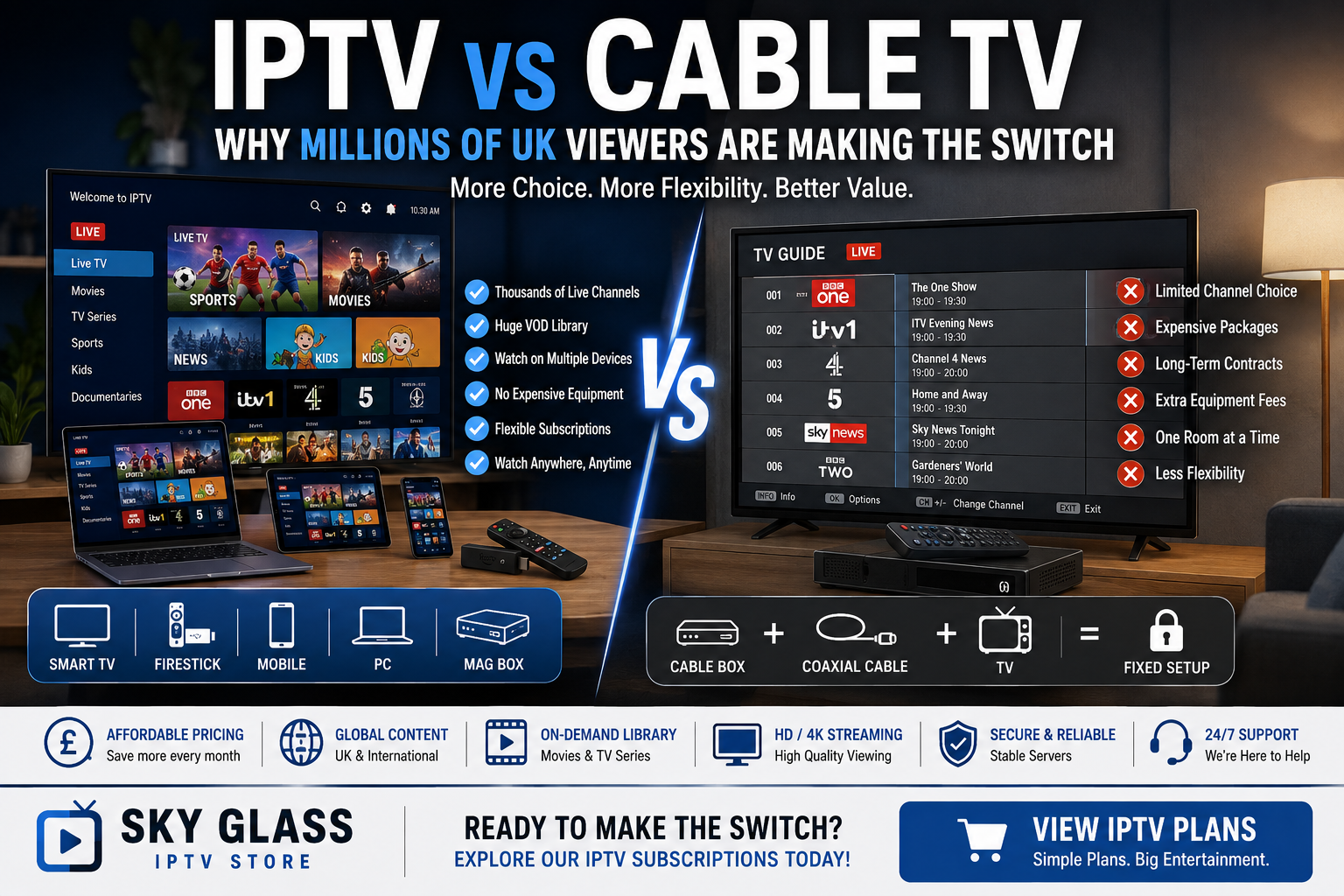
Traditional television is changing quickly. UK viewers who once relied mainly on fixed TV packages are increasingly watching content through internet-connected TVs, streaming platforms, apps and other online services. Ofcom’s latest research reflects that wider shift: streaming services are now a central part of how people discover and consume television, while viewing of traditional linear channels continues to decline.
That raises an obvious question: IPTV vs cable TV – which is actually better for viewers in the UK?
The answer depends on what you value most. IPTV can offer greater device flexibility, subscription choice and internet-based access, while traditional cable TV can provide a familiar, provider-managed experience. In this guide, we’ll compare the two across price, channels, sports, device compatibility, reliability, installation and overall value.
If you’re considering switching to IPTV, you can also explore the [Sky Glass IPTV Store] to see available subscription options and compatible devices.
What Is IPTV and How Does It Differ From Cable TV?
IPTV stands for Internet Protocol Television. In simple terms, it means television content delivered using internet protocol networks rather than a traditional television distribution method.
Ofcom describes IPTV as television channels delivered through the internet, particularly through connected or smart TV environments. IPTV can therefore sit alongside traditional broadcast methods such as digital terrestrial television, cable and satellite.
The important distinction is how the content reaches your screen.
With a traditional cable TV service, television signals are delivered through a cable network and usually accessed using provider-supplied equipment such as a set-top box. Your TV package is normally structured around the provider’s available channels, packages and services.
With IPTV, the content is delivered over an internet connection. Depending on the service, you may watch through a Smart TV application, streaming device, computer, smartphone, tablet or dedicated IPTV hardware.
That flexibility is one of the biggest reasons IPTV has attracted attention from modern viewers.
For example, an IPTV user might watch on a Samsung Smart TV at home, continue watching on a laptop in another room, or use a compatible mobile device while travelling. The exact options depend on the provider and application being used.
Traditional cable television, by comparison, tends to be more closely connected to the provider’s hardware and network.
The difference can be summarised simply:
| Feature | IPTV | Cable TV |
| Delivery | Internet connection | Cable network |
| Main equipment | Smart TV, app, streaming device or compatible hardware | Usually provider set-top box |
| Device flexibility | Generally high | Provider-dependent |
| Internet required | Yes | Traditional cable delivery does not depend on home broadband in the same way |
| Live TV | Yes, depending on service | Yes |
| On-demand content | Provider-dependent | Commonly available |
| Mobile viewing | Often available | Depends on provider |
| PC/Laptop viewing | Often available | Depends on provider |
| Subscription flexibility | Varies by provider | Usually package-based |
| International content | Provider-dependent | Package-dependent |
The technology itself isn’t inherently a choice between “good” and “bad.” The better option depends on how you watch television.
IPTV vs Cable TV – Quick Comparison
If you want the short version, IPTV generally has the advantage when flexibility and multi-device viewing are your priorities.
Cable TV can make more sense if you prefer a traditional television setup where your provider supplies the equipment, manages the service and handles most of the technical side for you.
Here’s how the two compare in the areas that matter most.
Price: IPTV can offer flexible monthly, multi-month and annual plans, while cable packages often work around structured bundles and optional premium additions.
Device choice: IPTV can be used across Smart TVs, streaming devices, computers and mobile devices when supported by the provider. Cable is usually more closely associated with a set-top box, although many traditional providers now have apps as well.
Sports: Both can provide sports, but the exact channels and rights depend on the service and package.
On-demand content: Both IPTV and cable can offer movies and series alongside live TV.
Installation: IPTV can often be installed using an existing internet-connected device, while cable TV may require provider equipment and installation.
Internet dependency: IPTV relies on your internet connection, so broadband quality matters. Traditional cable television uses a dedicated delivery network for its core TV service.
Flexibility: IPTV generally wins if you want to move between different compatible devices.
The important point is that there isn’t one universal winner. The best choice is the one that fits your household.
IPTV vs Cable TV Cost – Which Is Cheaper?
Cost is one of the biggest reasons people compare IPTV with traditional television.
However, comparing only the advertised monthly price can be misleading. You need to consider what is included, how long the subscription lasts and whether premium content costs extra.
How Much Does Cable TV Cost in the UK?
Traditional television packages can vary considerably depending on the provider and package.
A basic package may include a selection of entertainment and general-interest channels, while additional packages can add sports, movies, premium entertainment and other specialist content.
The total cost can therefore increase as you add the channels your household actually wants.
Some viewers may also pay for additional equipment, multi-room services or bundled broadband and television packages.
That doesn’t necessarily make cable poor value. A household that already receives broadband, television and other services in one package may find the convenience worthwhile.
How Much Does IPTV Cost?
IPTV pricing varies considerably between providers.
Depending on the service, you may find:
- 1-month subscriptions
- 3-month subscriptions
- 6-month subscriptions
- 12-month subscriptions
- Multi-device or multi-connection packages
Longer subscriptions often have a lower effective monthly cost.
For example, a provider might charge £15 for one month but offer a 12-month package at a much lower effective monthly rate.
If you’re comparing plans, don’t just look at the headline price. Calculate the effective monthly cost and then compare what you actually receive.
You can view the available options through the IPTV Subscription page.
Is the Cheapest IPTV Always the Best?
No.
An extremely low price doesn’t automatically mean you’re getting better value.
A useful comparison should consider:
- Streaming reliability
- Channel selection
- Video quality
- VOD availability
- Device compatibility
- Customer support
- Subscription flexibility
- Transparency
A service that costs slightly more but works consistently may provide considerably better value than an extremely cheap service that frequently fails during peak viewing hours.
IPTV vs Cable TV for Channels and Content
Channel selection is another major consideration.
Traditional cable packages generally organise channels into predefined bundles. You might have a basic package and then add specialist options for sports, movies or other content.
IPTV services can structure their channel libraries differently.
Depending on the provider, an IPTV subscription may include categories such as:
- UK entertainment
- News
- Sports
- Movies
- Documentaries
- Kids
- Lifestyle
- International channels
- Music
- On-demand movies
- TV series
However, channel numbers alone don’t tell you whether a service is good.
A provider advertising thousands of channels may not necessarily offer more useful content than a smaller, better-organised service.
What matters is whether the service includes the channels you actually watch and whether those channels are delivered reliably.
Live TV vs On-Demand Content
Modern viewers also expect more than linear television.
They want to be able to switch between live channels, movies and series without changing services or devices.
Many IPTV platforms therefore combine live television with VOD libraries and, depending on the provider, features such as catch-up television and electronic programme guides.
Traditional cable providers have also evolved in this area. Modern cable and pay-TV services frequently include on-demand libraries and companion applications.
So the difference isn’t simply “IPTV has VOD and cable doesn’t.”
The more useful question is:
Which service gives you the combination of live channels and on-demand content you actually want at a price you’re comfortable paying?
IPTV vs Cable TV for Sports and Live Football
Sports are one of the biggest reasons viewers look beyond basic television packages.
Football fans may want access to competitions such as the Premier League and Champions League, while other households may be interested in cricket, boxing, motorsports or other live events.
Traditional television providers can offer premium sports packages, but these may come as additional subscriptions on top of a basic television package.
IPTV can offer a different approach, with sports content potentially included within a broader subscription depending on the provider’s legitimate content rights.
This can make IPTV attractive to viewers who prefer having live television and sports within one flexible service.
But there is an important distinction that every UK viewer should understand.
Not every IPTV service is legitimate.
IPTV is simply a method of delivering television over the internet. The legality of a particular service depends on the content it distributes and whether it has the necessary rights.
The UK government specifically warns that streaming devices and services can be used illegally when they are adapted to provide access to subscription television, films or sports content without the appropriate permission.
So when comparing IPTV services, don’t judge them purely by channel count or price.
Look for a provider that operates transparently and provides content through legitimate arrangements.
If you’re researching a provider, you can also explore the Sky Glass IPTV Store and review its available service information before choosing a subscription.
IPTV vs Cable TV – Device Flexibility
This is where IPTV can have a particularly strong advantage.
Traditional cable television has historically been built around the television and provider-supplied set-top box.
IPTV can be much more flexible because the service may be accessible through compatible applications and devices.
Smart TVs
Many IPTV services support compatible Smart TV platforms, allowing viewers to use their television without purchasing a traditional cable box.
Depending on the provider and application, this can include platforms such as:
- Samsung Smart TV
- LG Smart TV
- Android TV
- Google TV
- Sony Smart TV
- Hisense Smart TV
Firestick
Streaming devices such as Amazon Fire TV can provide another way to access compatible IPTV applications.
This can be useful for older televisions that don’t have modern Smart TV functionality.
For detailed setup instructions across different devices, see the IPTV Installation Guide.
Phones and Tablets
Mobile viewing is another area where internet-based television can be convenient.
If your IPTV provider and player support mobile devices, you may be able to watch compatible content on an Android phone, tablet, iPhone or iPad.
PC and Mac
IPTV can also work on computers.
A compatible IPTV player can allow users to watch live channels and other content on a Windows PC, laptop or Mac.
This is particularly useful for students, people working from home or households where the main television is already being used.
MAG Boxes and Other Dedicated Devices
Some IPTV users prefer dedicated hardware such as MAG boxes or Android TV devices.
Again, compatibility depends on the particular provider and service configuration.
The major advantage here is choice: instead of being tied to one type of television hardware, you can often choose the device that best suits your home.
IPTV vs Cable TV – Installation and Setup
Installation is another area where the experience can be very different.
With traditional cable television, the provider may arrange installation, supply a set-top box and configure the service for you.
That’s convenient for people who don’t want to deal with applications or device settings.
IPTV can have a simpler hardware footprint.
In a typical setup, you may need:
- A compatible device
- A reliable internet connection
- An IPTV player or supported application
- Your subscription credentials
- A few minutes to configure the service
Once the application is installed, you generally enter the credentials provided by the service and allow the channel list or programme guide to load.
This makes IPTV particularly attractive to people who already own a Smart TV or streaming device.
If you’re new to the process, the IPTV Installation Guide provides a useful starting point for understanding how IPTV can be configured on different devices.
IPTV vs Cable TV – Reliability and Buffering
This is one area where IPTV needs to be discussed honestly.
IPTV depends on internet connectivity.
That means the quality of your broadband, home network and Wi-Fi connection can affect your viewing experience.
If your internet connection is unstable, IPTV may experience:
- Buffering
- Delayed loading
- Resolution changes
- Playback interruptions
However, that doesn’t mean IPTV is automatically less reliable than cable.
The quality of the IPTV provider’s infrastructure also matters.
A well-designed service needs appropriate server capacity and network infrastructure to handle demand, particularly when large numbers of people watch live events simultaneously.
Recent UK work on the future of television distribution also highlights factors such as broadband capability, network infrastructure, live-event traffic and platform quality as important considerations in an IP-based television ecosystem.
What Causes IPTV Buffering?
Before blaming IPTV itself, check the basics:
Internet speed: Your connection needs enough bandwidth for the quality you’re trying to stream.
Wi-Fi: A weak wireless signal can cause problems even when your broadband package is fast.
Device performance: Older or underpowered hardware may struggle with high-quality video.
Provider infrastructure: Server capacity and network design can affect performance.
Peak-hour demand: Live events can produce significant traffic spikes.
If you’re experiencing problems, don’t immediately assume you need a VPN or a new subscription.
Test the connection, try another device and determine where the problem actually originates.
IPTV vs Cable TV – Flexibility and Contracts
Another major difference is subscription flexibility.
Traditional television services often revolve around structured packages. You choose a plan, add optional services and may agree to a minimum contract period.
That model works well for households that want a predictable, all-in-one television package.
IPTV can provide a different experience.
Depending on the provider, you may be able to choose between shorter and longer subscription periods.
This can be particularly useful for:
- Students
- Renters
- People who move frequently
- Temporary accommodation
- Multi-device households
- Viewers who don’t want a long television contract
Longer plans can also reduce the effective monthly cost, although you should always evaluate the provider before committing to a long-term subscription.
Flexibility doesn’t automatically make IPTV better, but it can make it more suitable for modern viewing habits.
IPTV vs Cable TV for International Channels
International content is another area where internet-based television can be attractive.
A UK household may have family members interested in content from different countries or languages.
Depending on the provider and its legitimate content rights, IPTV services can offer access to a broader range of international programming than some conventional packages.
Potential categories can include:
- European channels
- Asian channels
- Australian channels
- Middle Eastern programming
- African channels
- North American channels
Traditional television providers also offer international channel packages, so this isn’t exclusively an IPTV advantage.
The important difference is the potential flexibility of the IPTV model.
If international programming is important to your household, compare the actual channels available rather than relying on a provider’s overall channel count.
You can explore the Sky Glass IPTV Store to see what type of content and subscription options are available.
IPTV vs Cable TV – Which One Is Better for You?
There is no universal answer.
The better choice depends on your viewing habits.
IPTV May Be Better If You:
- Want flexible subscription options
- Watch television on multiple devices
- Already have a Smart TV or streaming device
- Want to watch on a laptop or phone
- Prefer internet-based television
- Want access to live TV and VOD in one service
- Have a reliable broadband connection
- Prefer not to depend on traditional TV hardware
Cable TV May Be Better If You:
- Prefer a traditional television setup
- Want provider-supplied hardware
- Prefer having the provider handle installation
- Don’t want your core TV service dependent on home broadband
- Already have a cable bundle that represents good value
- Prefer a familiar set-top-box experience
Here’s the simple version:
| Your Priority | Likely Better Option |
| Flexible viewing | IPTV |
| Traditional setup | Cable TV |
| Multiple compatible devices | IPTV |
| Provider-managed hardware | Cable TV |
| Internet-based viewing | IPTV |
| Dedicated TV infrastructure | Cable TV |
| Flexible subscription options | IPTV |
| Simple traditional experience | Cable TV |
| International flexibility | IPTV may offer more choice |
| Broadband-independent core TV | Cable TV |
The important word is may.
A poor IPTV service won’t automatically become better simply because it’s IPTV, and an expensive cable package isn’t necessarily bad value if it provides everything your household needs.
Is IPTV Legal in the UK?
This is an important question because the term IPTV is sometimes incorrectly treated as synonymous with illegal streaming.
It isn’t.
IPTV is a technology for delivering television over internet protocol networks.
The legal question concerns the particular content and service being provided.
Ofcom recognises IPTV as internet-delivered television and discusses it as part of the broader evolution of connected television.
At the same time, UK authorities have warned about illicit streaming services that distribute copyrighted television, films or sports without the necessary permission.
For consumers, the safest approach is to choose transparent services and make sure you’re paying for content through legitimate channels.
When evaluating an IPTV provider, consider:
- Does the provider clearly explain its service?
- Is there identifiable customer support?
- Are subscription terms clear?
- Are payment and renewal terms transparent?
- Does the provider make realistic claims?
- Does it have appropriate rights to distribute the content it offers?
Don’t assume that a service is legitimate simply because it works on a Firestick, Smart TV or MAG box.
The device is not what determines legality. The content and how it is distributed matter.
Sky Glass IPTV Store – What Should You Look for in an IPTV Provider?
If you’ve decided that IPTV fits your viewing habits, the next question is choosing the right provider.
This is where you should look beyond marketing claims.
A good IPTV comparison should consider:
Channel Selection
Look for the channels you actually watch rather than simply choosing the provider with the largest advertised number.
Streaming Quality
Check whether the provider supports the video quality you want and whether your internet connection and device can handle it.
Device Compatibility
Make sure your Smart TV, Firestick, Android device, computer or other hardware is supported.
Customer Support
Good support can make a significant difference when configuring a new device or troubleshooting connection problems.
Subscription Options
Look for plans that fit your budget and viewing habits instead of automatically choosing the longest plan available.
Reviews and Reputation
Independent customer feedback can help you understand how other users experience the service.
If you’re researching Sky Glass IPTV Store, you can visit the Reviews Page to check available feedback before making your decision.
You can also explore the [Buy IPTV Subscription] page for subscription information.
Interested in Becoming an IPTV Reseller?
IPTV isn’t only changing how consumers watch television. The growth of internet-based television has also created interest among people looking to build businesses around subscription services.
If you’re researching the business side rather than simply looking for a personal subscription, the IPTV Reseller Panel page provides information about reseller functionality and available options.
For most readers, however, the first priority should simply be finding a reliable service that fits their household’s viewing needs.
Frequently Asked Questions
Is IPTV better than cable TV in the UK?
It depends on what you need. IPTV can be better for viewers who value flexible subscriptions, multiple compatible devices and internet-based viewing. Cable TV may be better for people who prefer provider-managed hardware and a traditional television setup.
Is IPTV cheaper than cable TV?
It can be, but pricing varies considerably between providers and packages. Compare the total cost, contract length, included content, device support and premium additions rather than comparing only the advertised monthly price.
Can I watch IPTV on my Smart TV?
Yes, if the IPTV provider and compatible application support your television platform. Smart TVs can be one of the most convenient ways to use an internet-based television service.
Can I use IPTV on a Firestick?
Many IPTV services support compatible Fire TV devices through supported applications. Always check the provider’s current installation instructions and use legitimate services.
Does IPTV require fast internet?
IPTV requires a stable internet connection because the television content is delivered online. The bandwidth required depends on the stream quality, number of simultaneous streams and other activity using your connection.
Can IPTV replace cable TV?
For many households, IPTV can replace traditional cable television if they have reliable broadband and the IPTV service provides the channels and features they actually need.
Is IPTV legal in the UK?
IPTV technology itself is not illegal. The important issue is whether a particular provider has the appropriate rights to distribute the content it offers. UK authorities distinguish legitimate streaming from illicit services that provide copyrighted content without permission.
Does IPTV have sports channels?
Some IPTV services offer sports content, but the exact availability depends on the provider and its legitimate content rights. Always verify that the service you’re using is authorised to distribute the content.
Which is better for international channels, IPTV or cable?
IPTV may offer greater flexibility for international programming, but it depends entirely on the provider. Traditional television providers can also offer international channel packages.
Does IPTV buffer more than cable TV?
Not necessarily. IPTV performance depends on broadband quality, Wi-Fi, device performance, provider infrastructure and network conditions. Cable uses different delivery infrastructure, so the causes of interruptions can differ.
IPTV vs cable TV – which should you choose?
For viewers who value flexibility, multi-device access and internet-based television, IPTV can be an excellent alternative to traditional cable. You can potentially watch across Smart TVs, streaming devices, computers and mobile devices while choosing a subscription structure that fits your viewing habits.
Cable TV still has advantages. It offers a familiar experience, established infrastructure and provider-managed equipment that many households appreciate.
The most important thing is not to choose based solely on the word “IPTV” or “cable.”
Choose based on what you actually need.
Consider your budget, internet connection, favourite channels, sports requirements, preferred devices and how much flexibility you want.
If you’re considering making the switch, explore the Sky Glass IPTV Store, review the available IPTV Subscription Plans, and check the Reviews before deciding.
For help getting started on your preferred device, visit the IPTV Installation Guide.
And if you’re interested in the business side of IPTV, you can learn more about the IPTV Reseller Panel.
The future of television is increasingly connected, and IPTV is one part of that transition. Whether it is the right choice for you ultimately comes down to one simple question:
Does the service give you the content, flexibility, reliability and value you actually want?